Three Free Content Templates: Brief, Source Check and Publishing Checklist
Three original TXT templates that you can open and copy directly. Edit the content brief, source verification, and broadcast control in a single workflow.
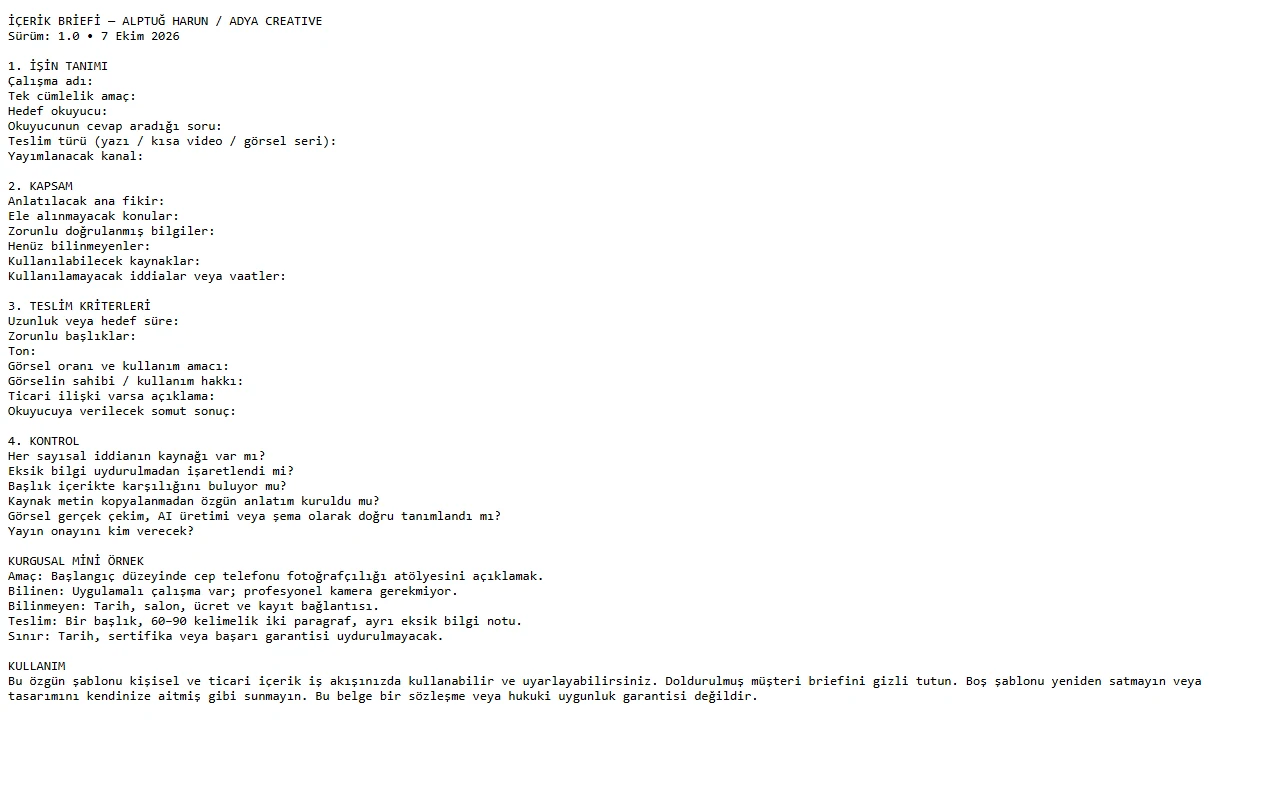
The problem with a content study is sometimes not at the speed of writing, but in the uncertainty of what will be considered complete. The title is ready but the date is not confirmed; there is visual but the right to use is unknown; the draft has been saved but not opened alive. These three original work files are prepared for you to manage these stages without mixing them together.
File one: Content brief
Open content brief as txt. The file contains separate fields for purpose, reader, main question, known information, unknowns and delivery criteria. You can copy it and fill it in for your own work. No special software or account is required to use it; a plain text editor is sufficient.
Write the one sentence purpose first. Specify what question the reader will answer instead of 'producing a nice content'. The fictional workshop example in the file shows how to protect the missing date or price from being fabricated. Don't use the information in the example like the actual event announcement.
Second file: Source verification card
Open source verification card. Multiply the card for each important claim. Separately write the sentence you are going to publish, the source that supports it, and the detail that the source does not support. With the presence of a page, it is not the same as having your entire sentence verified.
For example, if the source says Saturday alone, don't decide the time yourself. On the card, narrow the claim or wait for the incomplete information to be verified. Keep the comment area open so that you don't turn personal evaluation into the information the source says directly.
Third file: Broadcast checklist
Open pre- and post-release checklist. Content, visual rights, page layout, and live broadcast control are separate sections. Mark items as past, left, or untested. Do not fill a box that you do not check as complete.
Type the actual broadcast address into different fields with the draft address so that you can reduce the risk of thinking that a change you see in the preview has been brought to life. If there is a function like the form, verify not only the message of success but whether the data has reached the expected location as well as your scope.
Combine three files with a single business ID
Type the same working name or identity at the beginning of each file. Brief defines scope, the source card checks claims, and the checklist tests delivery. Task-specific assessment approach It also emphasizes the pre-set of the measure of success; here we adapt it to the everyday content business.
You can use and adapt templates in your personal and commercial workflow; maintain the usage note in files. Do not publicly share copies filled with customer information. These documents are not a guarantee of platform approval, legal compliance or error-free publication. Their value is in converting the obscure business into visible controls.
Resources
- OpenAI - Evaluation best practices · 6 October 2026